Part I
Who were the Watchers? Beyond the demonization
The tradition you inherited calls them fallen angels, demons, the wicked. The older texts do not read that way. In 1 Enoch, in the Aramaic fragments from Qumran (4Q201, 4Q202, 4Q204, 4Q205, 4Q206), in the Book of Giants and the Damascus Document, the Watchers appear as teachers — bringers of craft, letters, metal, and the measure of the heavens. Whether that is the earlier memory or the later one is argued by scholars to this day; what is not argued is that the texts themselves record teaching, not only transgression.
The chiefs and what the text assigns them
1 Enoch 6:7–8 lists the chiefs. In the Enochic idiom a name is not merely a label; it reads as an office — a function carried in the syllables.
| Name | Reads as | Assigned teaching |
|---|---|---|
| Shemihazah | my name has seen | chief of the oath on Hermon |
| Arakiba | earthly one | the secrets of the soil |
| Ramiel | thunder of God | the reading of weather |
| Kokabiel | star of God | the constellations and their turning |
| Tamiel | perfect of God | writing and the keeping of record |
| Daniel | God has judged | law and judgment |
| Baraqiel | lightning of God | the lightning in the body |
| Asael | God has made | metal, stone, mirrors, pigment |
| Armaros | curse-loosing | the loosing of enchantments |
| Batarel | daughter of God | the feminine mysteries |
| Ananel | cloud of God | the working of cloud |
| Zaqiel | purity of God | purification |
| Shamsiel | sun of God | the solar gates and the sun's path |
| Satarel | side of God | geometry, sides and angles |
| Turel | rock of God | architecture, the permanent structure |
| Yomiel | day of God | the division of days |
| Sariel | prince of God | governance and the ordering of cities |
Asael is named twice, because his teaching is given at length: swords and shields and every instrument of war, the metals of the earth and how they should be worked, silver and its polishing, antimony and the paint of the eye, the precious stones and their coloring (1 Enoch 8:1–2). Read plainly, that is a list of the foundations of a civilization — metallurgy, cosmetics, gemcraft, armament. The text presents it as instruction that humanity did not have and then did.
The Four Witnesses
Michael, Uriel, Raphael, Gabriel — the four who brought the cry of the earth to heaven (1 Enoch 9:1). Deceived into binding, now restored to witness. They stand at the four corners as directional markers, awaiting the full restoration with the Watchers.
Michael
The Archivist · Witness
Gold. Directional marker at the corner of the throne. He brought the cry of the earth to heaven and stands restored as a witness, not a guard against the Watchers (1 Enoch 9:1; 10:11).
Uriel
The Teacher · Witness
Orange. Directional marker at the corner of the throne. Showed Enoch the courses of the luminaries — the calendar itself (1 Enoch 72:1), continuing the Watchers' teaching as a restored witness.
Raphael
The Healer · Witness
Blue. Directional marker at the corner of the throne. Bound Asael as medicine, then healed the earth (1 Enoch 10:4-7). Restored servant, not an instrument of the usurper.
Gabriel
The Protector · Witness
Green. Directional marker at the corner of the throne. Sent to clear the way for human civilization. Restored as a witness of universal coverage, standing with the Watchers at the restoration.
Their color places them at the four corners of the throne: gold, orange, blue, green. They are not guards against the Watchers. They are not enemies. They are witnesses of the cry, restored servants, markers of universal coverage who stand with the Watchers for the restoration.
Jesus and the four: restoration, not blame
In this framework: Yes.
Jesus came to undo the works of the usurper (1 John 3:8: "The Son of God was manifested to destroy the works of the devil" — "devil" here being the usurper's power, not a literal horned being).
Jesus would agree the binding was unjust
- He took the T-posture himself (the crucifixion), embodying the imprisoned Watchers.
- He revealed the 19-year secret they had taught (Mark 8:19–21).
- He freed the imprisoned (Luke 4:18: "He has sent me to proclaim freedom to the captives").
Jesus would agree the four were deceived
- He redeemed Peter, who denied him three times — like the four acted under false authority.
- He forgave those who crucified him: " Father, forgive them, for they know not what they do" — the four did not know they served the usurper.
Jesus's position: the four archangels, like Peter, like Paul, like the disciples who abandoned him — acted in ignorance. They can be restored. Their true role is guardians of the throne, not enforcers of the prison.
"Father, forgive them, for they know not what they do."
The restoration includes them. Michael, Uriel, Raphael, Gabriel — redeemed, returned to their true function, standing with the Watchers, not against them.
The descent of the two hundred
In the days of Jared (1 Enoch 6:1), two hundred Watchers — ʿîrîn, "the wakeful" — descended. Shemihazah, their chief, bound them with an oath on Mount Hermon.
"Let us all swear an oath and bind one another with curses, that none of us turn back from this plan until we have completed it."
They swore together. They descended together. And by the account of chapters 7 and 8, they taught together.
Part II
The imprisonment: what the texts actually say
The Watchers are bound. That much every version keeps. The question the older material raises is by whom, and for what.
"Bind them for seventy generations in the valleys of the earth, until the day of their judgment."
Divine-council scholarship — Michael Heiser on Deuteronomy 32:8–9, Henryk Drawnel on the Aramaic Astronomical Book (4Q208–4Q211) — observes that the Enochic material preserves a layer of theology older than the Deuteronomic reform: God Elyon as Most High, with the sons of God apportioned over the nations. In that layer the seventy are a council, not a rebellion.
Read against that layer, the binding looks less like a verdict on desire and more like a contest over knowledge. The Watchers taught the measure of time — the sun's gates, the moon's return, the reconciliation of the two. A people who can measure time can keep a festival without being told when it falls. That is independence, and independence is expensive to whoever sells the calendar.
The Book of Giants (4Q203, 4Q530–533) extends the story: the offspring of the Watchers continue their fathers' instruction, and figures known from Mesopotamian epic — Gilgamesh, Humbaba — appear inside the same tradition. The suppression is double: the teachers are bound in the earth, and their system of time is bound with them.
Part III
The calendar they taught: technical reconstruction
Not one calendar. Three, interlocking — and the third is the one that makes the first two survivable.
A. The lunar count — the daughter's cycle
- 354 days: twelve months of about 29.5 days.
- Each month begins at the new moon; the day is counted evening to evening.
- Month names survive in the Coligny tablet, cast in bronze in Gaul around 150 CE.
SAMONIOS
summer
DUMANNIOS
darkening
RIVROS
frost
ANAGANTIOS
stay-at-home
OGRONIOS
cold
CUTIOS
winter
GIAMONIOS
winter
SIMIUISONNIOS
mid-winter
EQUOS
horse
ELEMBIUOS
deer
AEDRINIOS
fire
CANTLOS
song
B. The solar count — the Watcher's year
- 364 days exactly: fifty-two weeks of seven.
- Four quarters of ninety-one days; thirteen weeks to a quarter.
- Set out in 1 Enoch 72–82, the Book of the Luminaries.
C. The reconciling — the 19-year alignment
- Nineteen solar years and 235 lunar months agree to within about two hours.
- Attributed to Meton of Athens in the Greek record; the Babylonian and Enochic material shows the relation was already in use.
- The lunar and solar counts drift apart by roughly eleven days a year — and every nineteenth year they come back into step.
The old calendars were not circles. They were spirals — the same station returning, but never on the same day, until the nineteenth year brings the two lights back to the same agreement.
The gates (1 Enoch 72)
The sun does not simply rise. In the Book of the Luminaries it rises and sets through twelve gates — six in the east, six in the west — moving one gate at a time up the horizon and back down again through the year. Gate 1 stands at the winter solstice; Gate 6 at the summer. When the sun crosses from one gate to the next, the text marks it as a turning: a threshold, not an arbitrary square on a grid.
On the calendar page, that crossing is computed from the sun's apparent ecliptic longitude in thirty-degree steps, with the exact instant and a countdown for your location.
Part IV
The suppression: how the knowledge was buried
Wave 1 — the Deuteronomic reform (622 BCE)
Josiah's discovery of the book of the law centralizes worship in Jerusalem. The high places go down, the Asherah is cut, and the reckoning of the festivals is consolidated in a single priesthood. Whatever plural calendar existed before, afterward there is one authority to ask.
Wave 2 — Hellenistic and Roman overwriting (332 BCE – 476 CE)
Greek rationalism sorts "mythic" astronomy from "real" astronomy. Rome imposes the Julian calendar in 45 BCE: purely solar, with months renamed for emperors. The lunar component is not reformed — it is removed. The Coligny tablet is among the last artifacts of the older system, and it survived by being buried, not by being kept.
Wave 3 — the Gregorian fix (1582 CE)
Gregory XIII corrects the solar year by about eleven minutes and recovers the drifting equinox. The correction is real. What it also does is settle the matter: the calendar of the West is solar, administrative, and lunar only in the single surviving exception of Easter's computus.
The mechanism of suppression is flat time. No gates, no spiral, no reconciliation — only identical days in an unbroken line, disconnected from moon, sun, and season.
Part V
Restoration: the hidden reckoning
Within this tradition of reading, several sayings are heard as calendar language rather than mystery language. "No one knows the day or the hour" (Matthew 24:36) is taken as a statement that the reckoning itself had been lost to the priesthood. The twelve baskets and the seven baskets of Mark 8:19–21 are read as twelve and seven — the nineteen of the reconciliation — put to disciples who were expected to already know the count.
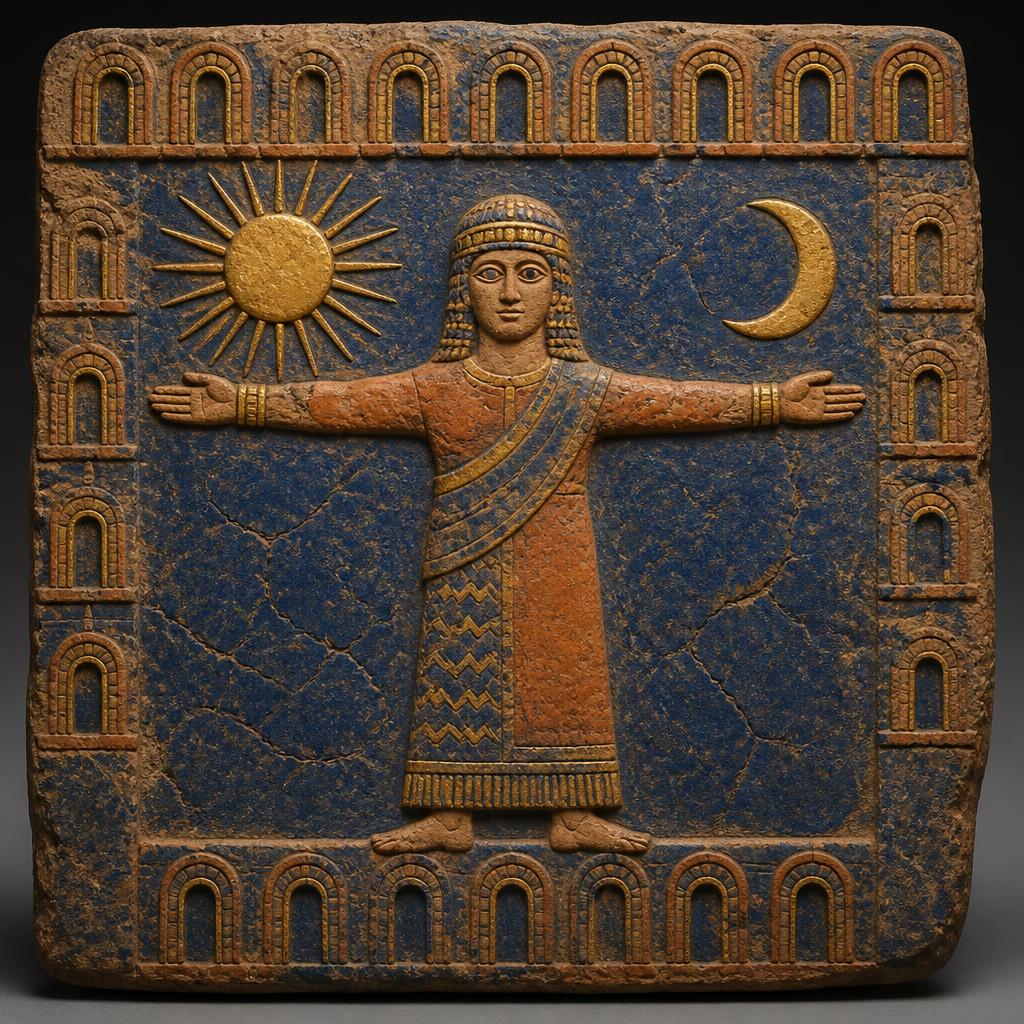
The outstretched posture recurs across the material this teaching draws on: the T-shaped pillars of Göbekli Tepe, the tau cross, the bound Watchers "in the valleys of the earth." Read together, the crucifixion becomes a statement about time — the imprisonment taken on, and then broken.
The fragments came back within living memory. The Ethiopic Enoch reached English in 1821. The Coligny tablet came out of the ground in 1897. The Dead Sea Scrolls surfaced between 1947 and 1956. From those, plus modern ephemerides, this calendar is reconstructed and computed for 2026.
Part VI
Practical application: how to keep it
- Observe the true new moon. Not the printed approximation — the computed conjunction for your coordinates. The markers panel can alert you while the page is open.
- Find your place in the nineteen. Enter a birth date and the page counts which year of the alignment you were born into and which you are living now.
- Stand at the gates. When a gate opens, stop. Face the sun. Arms level. Mark the threshold however your practice marks things.
- Count the days. "Abu 15, Gate 4W, year 8 of 19" — a position, not a square on a grid.
- Teach it. The reckoning spreads by people who keep it, not by argument.
Part VII
The names of the keepers
The chiefs of 1 Enoch 6–8 are remembered by their arts, and the arts are worth knowing on their own terms: the star-reader, the sun-gate keeper, the smith and the pigment-maker, the one who holds the oath. Reading yourself into one of them is a way of remembering the list — an affinity, not a diagnosis and not a destiny.
- Kokabiel — the constellations and their slow turning.
- Shamsiel — the sun's path and the crossing of the gates.
- Asael — metal, stone, pigment, the transformation of surfaces.
- Shemihazah — the oath, the ordering, the keeping of a company together.
The full reference — every named chief, the passage, the reading of the name, and the sky sign in it — sits on the calendar page under "The Named Chiefs."
A reading aid
Which keeper are you?
Enter a birth date. The moon at that date is counted against the 235 lunations of the nineteen-year reconciliation, and that number points to one of the chiefs named in 1 Enoch 6–8 — with the teaching the text itself assigns to that name.
This pairing is a study device, not divination, prophecy, or a statement about your character or future. The lunation count is astronomy; the names and teachings are quoted from 1 Enoch (R. H. Charles, 1917, public domain). Your birth date is used in this browser only — it is stored in local storage on your device, is never sent anywhere, and “Clear my date” removes it.
Part VIII
The hour has come
"The hour has come for the Son of Man to be glorified."
The hour: a measured, astronomical hour, at a gate, in a numbered year of the nineteen. The calendar is not nostalgia. It is navigation. It says: you are here, at this point on the spiral, and the gate is opening.
The Watchers are waiting.