Part I
The memory is everywhere
You were taught that Noah's flood was a local Mesopotamian event — a river in spate, exaggerated into myth over centuries. That reading explains the Mesopotamian texts. It does not explain why the same story sits in Greece, in India, in China, across Mesoamerica and the Andes, among Hopi and Cherokee, across Australia and the Pacific.
Strip the names away and the same skeleton keeps appearing:
- A warning given to one person in advance
- A vessel, a raft, a log, a reed, or high ground
- Animals, seed, or lineage carried through
- The destruction of a prior race or age
- A landing on a mountain
- A bird, or another test of whether the water has fallen
- A sign in the sky and a promise attached to it
- The world repopulated from the few
Folklorists offer three explanations for that spread: shared ancestry of stories, diffusion along trade and mission routes, and independent invention in flood-prone places. This page holds a fourth alongside them — that the traditions are remembering something that happened. Read the comparison and weigh it yourself.
Part II
The flood mapped
Tap a marker to read that tradition; the table below sets them side by side.
Akkadian / Babylonian
Atrahasis / Gilgamesh XI
Mesopotamia
- Source
- Atrahasis epic (c. 1700 BCE); Gilgamesh tablet XI
- Warned one
- Atrahasis / Utnapishtim, warned by Ea
- Vessel
- A sealed cube-like boat, animals and craftsmen aboard
- Bird
- Dove, swallow, raven released in turn
- Sign
- The gods gather to the offering; Ishtar's lapis necklace as remembrance
- Note
- The closest textual parallel to Genesis, and older in manuscript.
| Tradition | Region | Warned one | Vessel | Bird | Sign |
|---|---|---|---|---|---|
| Atrahasis / Gilgamesh XI | Mesopotamia | Atrahasis / Utnapishtim, warned by Ea | A sealed cube-like boat, animals and craftsmen aboard | Dove, swallow, raven released in turn | The gods gather to the offering; Ishtar's lapis necklace as remembrance |
| Noah | Levant | Noah, called tzaddik | The ark, three decks, pitch inside and out | Raven, then dove three times | The bow set in the cloud |
| Deucalion and Pyrrha | Greece | Deucalion, warned by Prometheus | A chest (larnax) | — | Stones cast behind them become people |
| Manu and the fish | India | Manu, warned by a fish he had spared | A boat towed by the fish's horn | — | The boat tied to the northern mountain as the waters fall |
| Nüwa mends the sky / Yu the Great | China | Nüwa; later Yu, who channels the waters | None — the waters are engineered away | — | The pillars of heaven repaired with coloured stones |
| The Fourth Sun | Mesoamerica | Tata and Nene, warned by Tezcatlipoca | A hollowed cypress log | — | The age ends and a new sun is kindled |
| The wooden people destroyed | Maya lowlands | — | — | — | A black rain, and the survivors become monkeys |
| Emergence from the Third World | Southwest North America | The people led by Spider Grandmother | Hollow reeds | — | Emergence through the sipapu into this world |
| The dog that warned | Southeast North America | A man warned by his dog | A raft | — | The waters recede and the land is remade |
| Viracocha's flood | Andes | Two survivors at Tiwanaku | Caves and boxes | — | Viracocha remakes people from stone at Tiwanaku |
| Tiddalik and the great water | Australia | Varies by nation | — | — | The waters are released and the land re-formed |
| Ruatapu / Tāwhaki floods | Pacific | Tāwhaki, or the survivors of Ruatapu's wave | Canoes and raised ground | — | The waters called down as retribution |
Part III
Why the flood: the judgment of the giants
Genesis gives a reason in a single compressed verse about the wickedness of humanity. 1 Enoch 6–10 gives a longer one, and it is not about human morality at all.
"Bind Semjaza and his associates… bind them fast for seventy generations in the valleys of the earth… and destroy the spirits of the reprobate and the children of the Watchers, for they have wronged mankind."
In this account the flood is aimed at the Nephilim — the offspring of the descent. 1 Enoch 7:3–5 describes them consuming everything the people produced, then turning on the people, then on one another. Read as narrative rather than as metaphor, that is a population the land could not carry.
Two things follow that Genesis alone does not give you. First, the Watchers are bound, not drowned — which is why the mounds matter. Second, Noah's qualification is tzaddik: a word usually rendered "righteous". This tradition reads it in its older sense of one who keeps to a measure — a keeper of order, and so a keeper of the count. That is a reading of the word, not a lexicon entry; standard Hebrew lexicons render it as just or righteous.
Part IV
The ark as library
The Book of Jubilees — canonical in the Ethiopian Orthodox Church, found among the Dead Sea Scrolls — has Noah receiving instruction from the angels and writing it down, and has that written knowledge passed to his sons. In the Enochic material the content of such teaching is explicitly astronomical: the courses of the sun and moon, the gates, the reckoning of the year (1 Enoch 72–82, and the Aramaic Astronomical Book at Qumran, 4Q208–4Q211).
What that framework says came through the water:
- The nineteen-year reconciliation of sun and moon
- The twelve gates through which the sun rises and sets across the year
- The seventy sons of God and the apportioning of the nations (Deuteronomy 32:8, 4QDeut)
- A calendar answerable to the sky rather than to a throne
It also predicts something checkable: if the knowledge was distributed rather than lost, then the nations that carry the flood memory should also carry calendar fragments. They do — Babylonian intercalation, the Coligny tablet's five-year lunisolar scheme, the Qumran calendars, the Chinese and Hebrew lunisolar cycles, all reconciling sun and moon over nineteen years. Astronomers will tell you that is because nineteen years genuinely equals 235 lunations, and any careful culture finds it. Both explanations fit the evidence; only one of them is testable, and it is on the calendar page.
Part V
The bow in the cloud
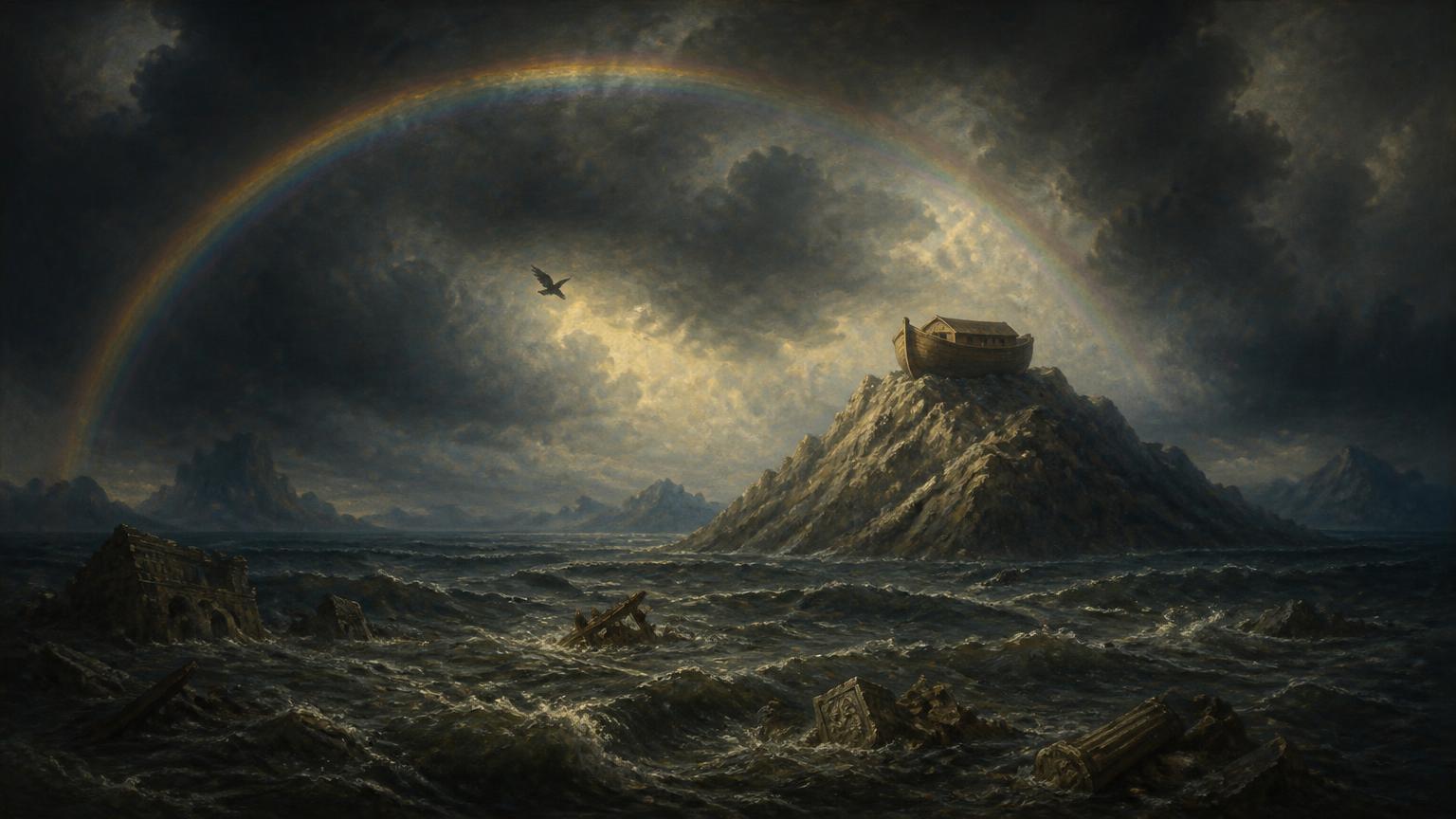
Genesis 9 sets a bow in the cloud as the sign of a covenant not to destroy the earth again. The Hebrew word is qeshet — a war bow, hung up. A weapon set aside.
Read in the council framework, the promise binds more than one party: the earth continues, the jurisdictions of the seventy stand, and the seasons — "seedtime and harvest, cold and heat, summer and winter, day and night" (Genesis 8:22) — do not stop. That last line is the calendar clause. The covenant is, in plain terms, a guarantee that the sky will keep time.
Part VI
The part the earth records
You do not have to take the texts on trust to accept that catastrophic flooding happened and was remembered. Here is the mainstream science, stated as it actually stands:
- Post-glacial sea-level rise (c. 20,000–6,000 BCE). Sea level rose roughly 120 metres as the ice sheets melted, drowning continental shelves worldwide. Not disputed. Coastlines that people lived on are now under water.
- Meltwater pulse 1A (c. 12,000 BCE). A rise of some 15–25 metres within a few centuries — fast enough to be lived through and remembered.
- The Missoula floods and Channeled Scablands. Repeated ice-dam failures carved eastern Washington in days. Well established.
- The Black Sea deluge hypothesis (c. 5600 BCE). Ryan and Pitman proposed a rapid Mediterranean inflow flooding a freshwater lake. Actively debated; some evidence supports a gradual rise instead.
- The Younger Dryas impact hypothesis (c. 10,800 BCE). An airburst or impact proposed to explain a black-mat layer with spherules and nanodiamonds. This one is contested and rejected by many specialists — treat it as a live argument, not a settled finding.
- Submerged sites. Structures in the Gulf of Khambhat and off Yonaguni are claimed as drowned cities; the dating and even the artificiality of both are disputed. Doggerland, by contrast, is securely established as a drowned inhabited landscape under the North Sea.
- Aboriginal Australian coastal traditions. Nunn and Reid argued that some accounts of lost coastline correspond to real sea-level change over 7,000+ years — a serious, published case for oral memory of a real flood.
There is no geological evidence for a single simultaneous global flood covering the mountains. There is abundant evidence for repeated, world-changing floods that scattered survivors and left a shared memory. This page argues the second, and says so plainly.
Part VII
The calendar as proof of survival
Göbekli Tepe watched the sky around 9500 BCE. Cahokia watched it around 1100 CE. 1 Enoch wrote it down somewhere near 300 BCE. Across that span the same two lights are being tracked and the same two counts reconciled.
Whether that is transmission from a single source or the same sky teaching the same lesson repeatedly, the practical conclusion is identical: the count is recoverable, and you can run it tonight.
Note on sources: flood summaries follow published translations and standard reference editions; geological entries state where a hypothesis is contested. Readings drawn from 1 Enoch, Jubilees and the divine-council material are this project's interpretation of contested ancient texts, not historical or scientific claims.