Part I
The mound as prison, the mound as throne
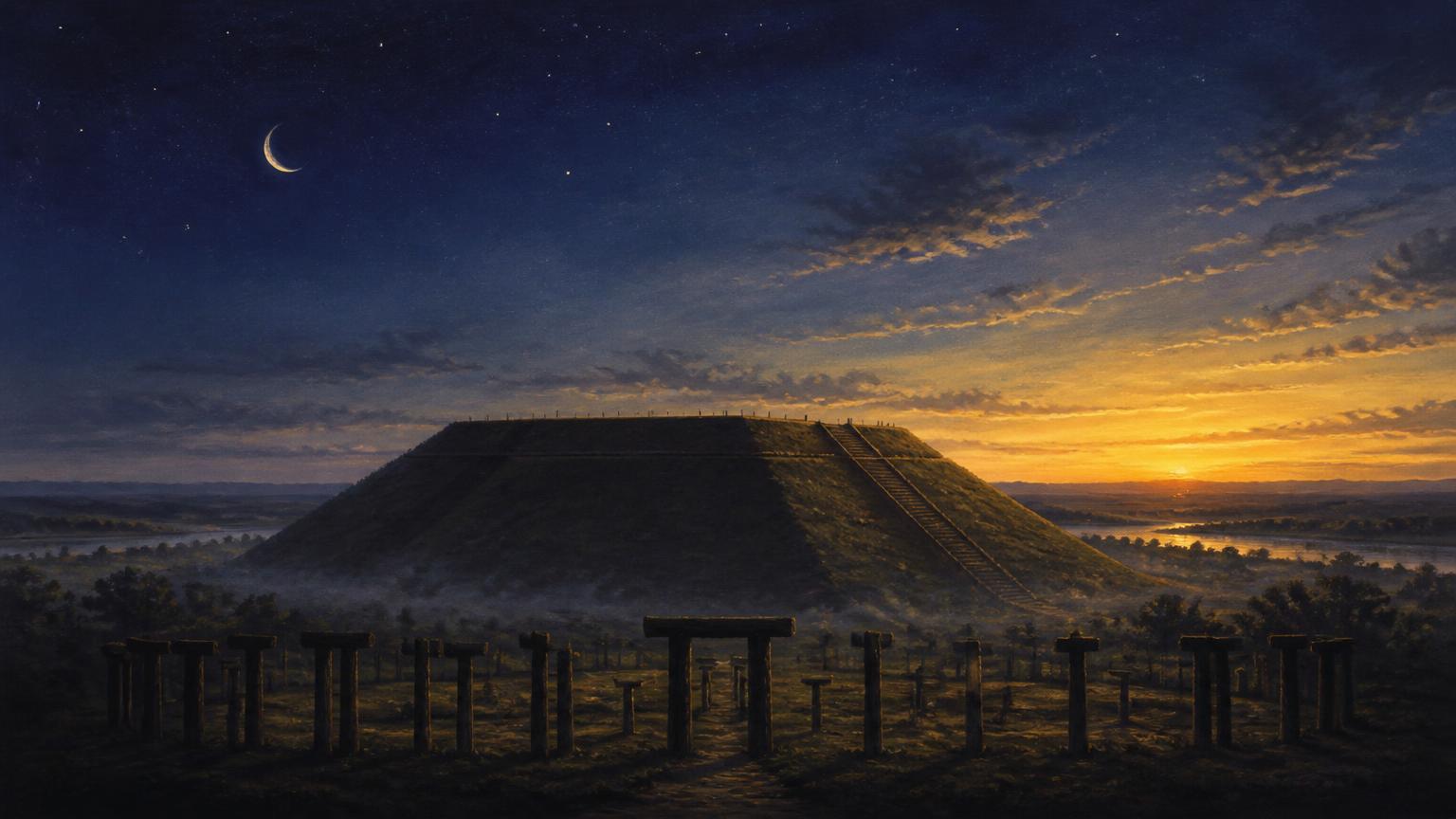
You have seen them. Perhaps you did not know what you were seeing. The earthen pyramid at Cahokia in Illinois, rising a hundred feet from the floodplain and exceeding the Great Pyramid in footprint. The T-shaped pillars of Göbekli Tepe in Turkey, deliberately buried by their own builders, carved with arms held out along the stone. Silbury Hill in Wiltshire, perfectly conical, refusing every excavation an answer. Newgrange in Ireland, older than Stonehenge, aligned to the winter solstice, its entrance a passage into the body of the earth.
Archaeology calls most of them burial mounds. This reading calls them something else: prisons, thrones, and above all memory devices built by people who were keeping something.
"Bind them for seventy generations in the valleys of the earth, until the day of their judgment."
The Ethiopic reads "valleys". The Aramaic vocabulary behind it carries the sense of hollows and excavations as easily as valleys — a philological observation, not a proof. Read that way, the binding is not in a landscape feature but in a made hollow: in the mound.
The giants are destroyed in the flood. The Watchers are not destroyed; they are bound in the earth. And the people who kept their teaching marked the places with geometry.
The T-posture as architectural key
Göbekli Tepe's pillars are anthropomorphic T-shapes: a vertical shaft for the spine, a horizontal top for the outstretched arms — and, on several pillars, arms and hands carved in low relief down the sides, meeting at a belt. That much is in the excavation reports. The reading offered here is that the shape is the posture of the bound: arms extended, fixed to the earth. Older than Rome, older than the cross.
- Göbekli Tepe: explicit in the pillar form itself
- Cahokia's Woodhenge: upright cedar posts in a solar-marking ring
- The alignments of Brittany and the menhirs of Corsica: standing human forms in stone
- The anthropomorphic stelae of the Levant and the Arabian peninsula
The T says: here stood one who taught; here lies one who was bound; remember. Take that as a way of reading a shape, not as an archaeological finding.
Part II
The great mounds: an interactive survey
Tap a marker. Each site gives you two layers, kept separate on purpose: the record — what excavation and survey actually establish — and the reading — what this tradition makes of it.
c. 9500–8000 BCE
Göbekli Tepe
Şanlıurfa, Turkey · 37.223°, 38.922°
open to visitors- The record
- Pre-Pottery Neolithic enclosures of monumental T-shaped limestone pillars carved with vultures, scorpions, foxes and snakes. The enclosures were backfilled in antiquity, which is why they survive.
- The reading
- The T-pillars are read here as anthropomorphic — a spine and outstretched arms, the posture of one bound. A circle of pillars becomes a circle of the bound, and the animal reliefs a memory of the sky as it stood then.
- Alignment
- Enclosure orientations and the animal reliefs are argued by some researchers to encode long-term sky change; the claim is contested and not settled archaeology.
- Visiting
- UNESCO World Heritage site with a visitor centre and elevated walkways near Şanlıurfa. Nearest airport GNY. Pillars are viewed from above; you cannot walk among them.
Part III
What the mounds encode
Three things recur across the sites in this survey. Two of them are measurable. One is a reading.
1. Solar thresholds
Newgrange takes the winter solstice sunrise down its passage. Cahokia's Woodhenge marks equinox and solstice sunrises. Teotihuacán's grid is rotated to specific sunset dates. This is documented archaeoastronomy — the least arguable thing on this page.
2. Cardinal discipline
Monk's Mound runs close to true north. Ziggurats face their corners to the compass. Getting that right without instruments requires patient observation of the sun and stars across years — the same observation the calendar rests on.
3. The count of nineteen
Claims circulate that Newgrange's spirals turn nineteen times, that Woodhenge held nineteen posts, that nineteen T-pillars stand in Göbekli Tepe's main enclosure. Say plainly what these are: counts made by enthusiasts, not by excavators, and the published site plans give other numbers. The nineteen-year reconciliation between sun and moon is real and measurable — you can watch it on the calendar page. Whether these stones were counting it is not established, and this page will not pretend otherwise.
What can be said without exaggeration: people at these sites tracked the sun with multi-generational precision, and the moon's return is the other half of any such reckoning.
Part IV
Plan your pilgrimage
You visit these places as a rememberer rather than a tourist. Practically:
Before you go
- Set your city on the calendar page and note the moon's age and the next solar threshold for your travel window.
- Check the access line on the site card above. Newgrange's solstice chamber is a lottery; Silbury cannot be climbed; Hermon should not be attempted at all.
- Book solstice and equinox dates months ahead — these are the days everyone else wants too.
- Read the site's own guidance on photography, drones and off-path walking, and follow it.
At the site
- Arrive at first light if the site opens then; the alignments were built for that hour.
- Walk the perimeter before you approach the centre. Take the long way round.
- Find the T — a pillar, a post, a facade, or the shadow a stone throws at noon. Stand before it.
- If it is permitted and you are not in anyone's way, stand with your arms out and be still for a few minutes. This is a posture of attention, nothing more is claimed for it.
- Say the names quietly if you wish: Shemihazah, Kokabiel, Asael, the two hundred, the seventy, God Elyon.
- Then simply watch the light move. Most of what these places have to give is given to people who stay longer than the average visit.
And when you stand in the T-posture, do not fear the four archangels. In the reading of these texts they are allies in the restoration, not its enemies: Michael the archivist does not strike you down — he welcomes a fellow keeper. Uriel the teacher shows you the gate. Raphael the healer has healed the ground. Gabriel the protector has cleared the way.
Respect
Many of these are living sacred sites, protected monuments, or both — Cahokia, Serpent Mound and the Hopi mesas are connected to descendant communities who are still here. Do not leave offerings, do not remove anything, do not climb what you are asked not to climb. Follow the posted rules over anything on this page.
Part V
The mounds and the flood
Every mound in this survey is post-flood in the framework of these texts — built after the waters, by those who remembered. What they carry is older than they are: the return of the sun through its gates, the return of the moon, and the reconciliation of the two.
The flood was meant to end that knowledge. The mounds are the argument that it did not.
Note on sources: dates, dimensions and alignments above follow published archaeology and site authorities. Everything labelled "the reading" is this project's interpretation of contested ancient texts, offered as interpretation and not as historical or scientific fact. Travel details change — verify with each site before you go.