Our interpretation
The T: where heaven meets time
Think of the T as a way to picture the calendar, not as a symbol that 1 Enoch says to draw. The line across the top is the horizon, where the Sun’s rising and setting positions shift through the year. The upright is a way to picture heaven and earth. Where the two lines meet is now: this moment when you observe the sky from where you stand.
Sunrise positions change over the year
Earth · where you stand
Ancient text
1 Enoch 72 describes gates for the Sun’s rising and setting and relates its motion to the year. It does not describe the calendar as a T or connect the gates to a cross.
Ancient symbol
Ezekiel 9:4 speaks of a mark (tav) on foreheads. Some ancient forms of the Hebrew letter tav were cross-like; the Greek letter tau is T-shaped. A resemblance does not establish that they were calendar symbols.
Christian tradition
Christians later gave the cross and tau theological meaning. Neither the New Testament nor 1 Enoch says Jesus’ cross represented Enoch’s solar gates; the exact shape of his cross is not settled.
Our interpretation
We use the intersection as a memory aid: look at the changing horizon, notice your place on Earth, and ask what time it is here and now. This is a visual parallel, not a claim of a shared ancient origin.
I · The shape that predates Rome
Older than writing
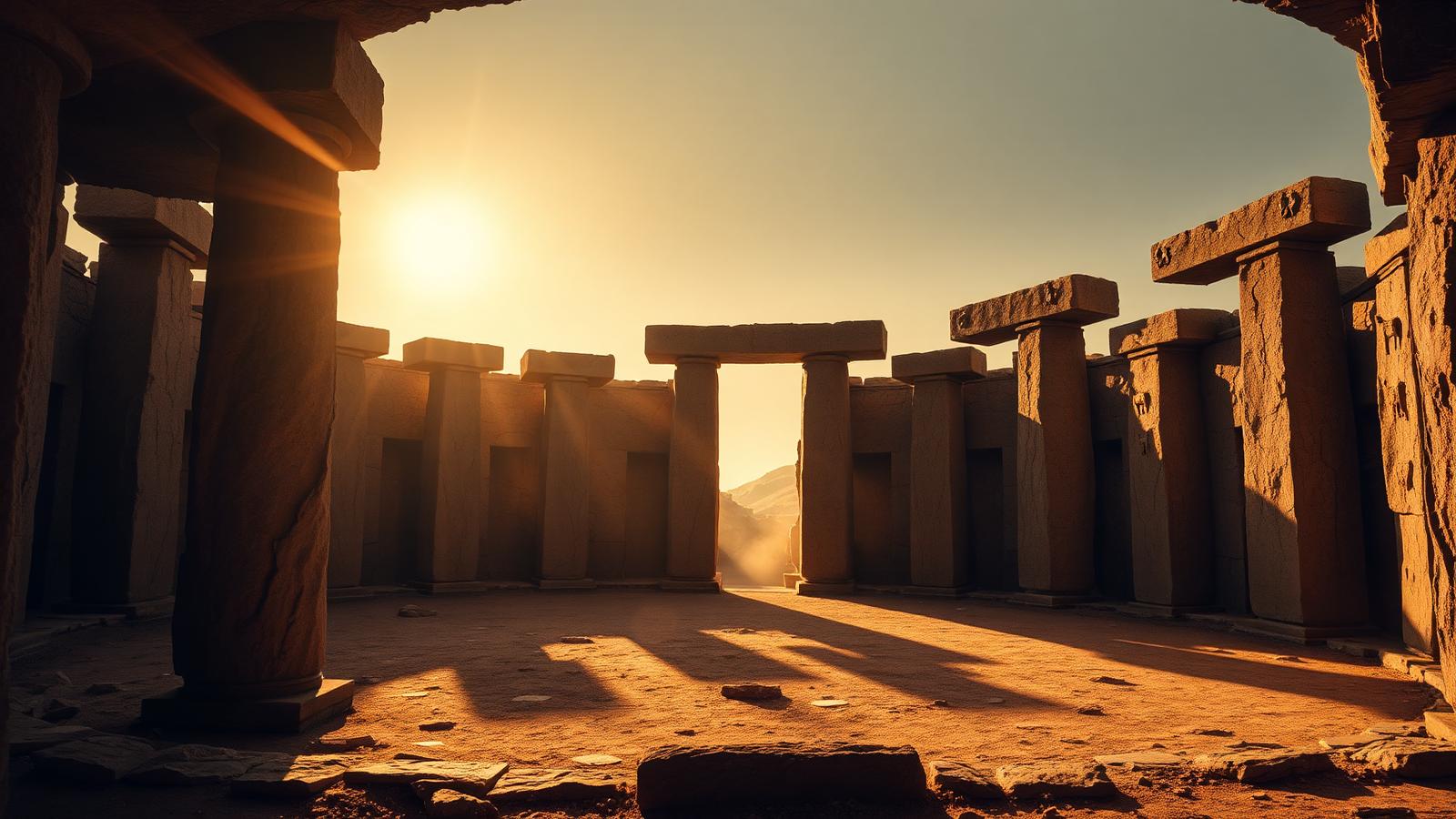
Most people meet the cross as a Christian sign. The shape itself is far older. At Göbekli Tepe in southern Turkey — a site archaeologists date to roughly 9500–8000 BCE — enormous T-shaped pillars stand in ringed enclosures, some over five metres tall. Many carry carved arms bent along their sides and hands meeting at the front: they are widely read as stylised human figures reduced to their essentials, a vertical spine and a horizontal span of arms.
The same silhouette recurs across distant cultures. These are separate traditions, not a proven single lineage — but the resemblance is worth sitting with.
Göbekli Tepe · c. 9500 BCE
T-pillars in stone rings, later deliberately backfilled — which is why they survived.
Cahokia Woodhenge · c. 900–1100 CE
Great cedar posts set in circles, aligned to solstice and equinox sunrises.
Standing stones · Europe
Menhirs and statue-stelae shaped with heads and shoulders — the body in stone.
The ankh · Egypt
A tau with a loop above it: the sign read as life. The djed pillar echoes the spine.
The T is older than writing. It is the geometry of the bound.
II · The posture of the Watchers
Bound, not erased
1 Enoch 10:12 has the instruction: bind them for seventy generations in the valleys of the earth. In the text the Watchers are not destroyed. They are held. Read as a posture, the image is cruciform — arms extended, fixed in place. One who reached out, who taught, who gave, now stilled.
We offer this as an interpretation, not as a claim about what the ancient authors intended. Taken that way, the T becomes a memory aid worn by the body: arms out, spine straight, saying I have not forgotten.
III · Jesus and the tau
Simple version
Roman crucifixion could involve an upright and a crossbeam, but the sources do not settle the exact shape of Jesus’ cross. The T-shaped tau and the familiar Latin cross are both ways crosses have been represented. Neither proves a connection to the gates in 1 Enoch.
Visual resemblance
An outstretched posture can resemble a T. 1 Enoch does not describe the bound Watchers in that pose.
Different accounts
The accounts of Jesus’ death and the Watchers’ binding are distinct stories; neither text identifies a shared calendar teaching.
Interpretation, not lineage
Cross forms and meanings developed over time. Their resemblance is a prompt for reflection, not evidence that one tradition descended from the other.
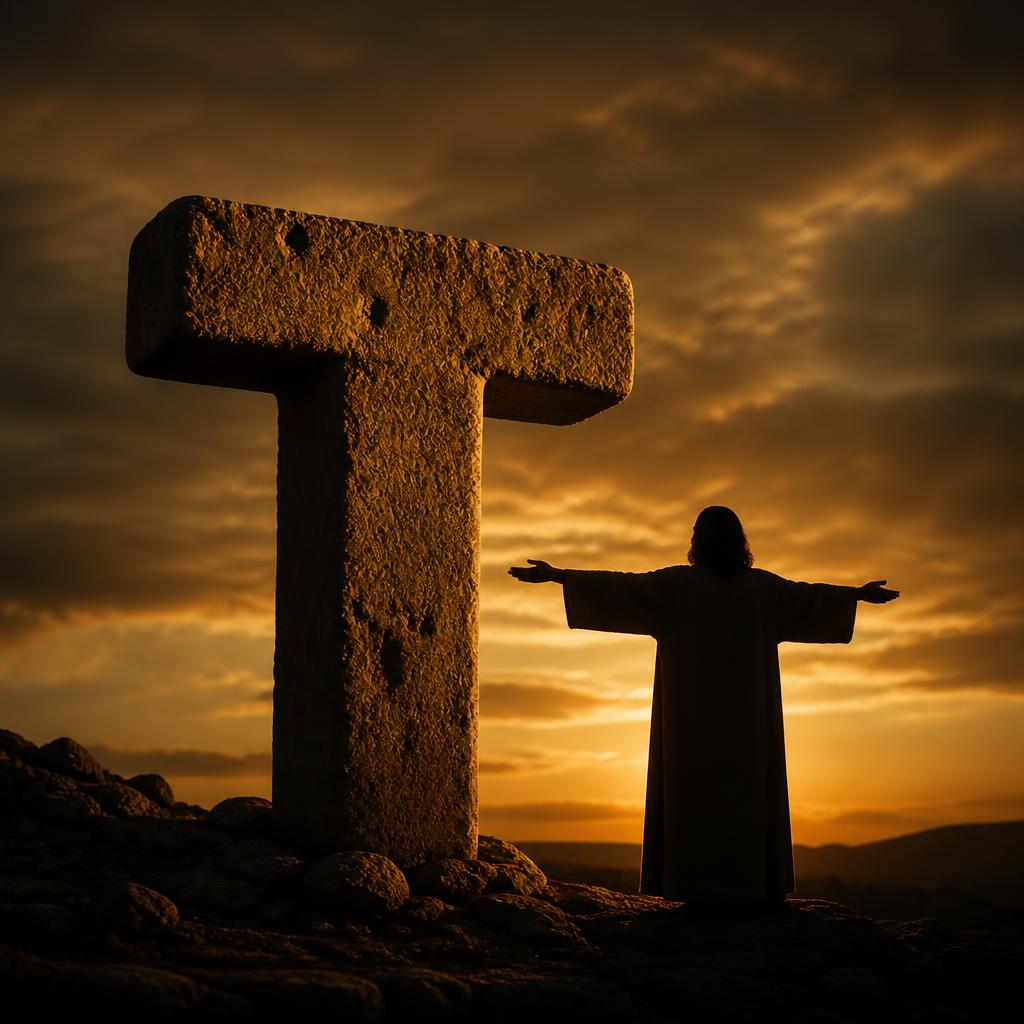
For this calendar, the T can be a way to remember the horizon, the earth beneath you, and the present moment. It is not evidence of a historical link between Jesus and the Watchers.
We offer this as a reading for study and practice, not as established historical or theological fact.
IV · Jesus and the tau
The crossbeam and the stake
Roman execution used several forms. The common method attested by ancient writers was a crossbeam (patibulum) carried by the condemned and fixed to an upright stake (stipes). Many historians of the period hold that this produced a T-shape (crux commissa) at least as often as the later Latin form. Which shape stood on any single day is not something the sources settle.
The two shapes carry different weight. The Latin cross leads the eye down the vertical: descent, heaven to earth. The tau leads the eye outward: extension, the arms of the one who teaches and the one who is held.
Sources for the diagram
- Roman execution practice and the T-shaped form: David W. Chapman, Ancient Jewish and Christian Perceptions of Crucifixion (Tübingen: Mohr Siebeck, 2008); and the reassessment of Latin sources in New Testament Studies, Cambridge Core.
- The Latin cross in later Christian art: "Cross and Crucifix," Catholic Encyclopedia (1913); and "Crosses and Crucifixes in Christian Art: Historical Study," Christian Iconography.
- The T-pillar as pre-Christian, ancient Near Eastern form: Schmidt et al. on Göbekli Tepe in the Cambridge Archaeological Journal; and Mithen, Richardson & Finlayson, "The flow of ideas: shared symbolism between WF16 in the south and Göbekli Tepe in the north," Antiquity 97 (2023): 829-849.
The diagram's theological reading — tau as extension rather than descent — is an interpretation offered for study and practice, not an established scholarly consensus.
We do not read the shape as descent. We read it as extension.
V · The T as practice
How to stand in the posture
- 01StandFeet shoulder-width, parallel. Root down through the heels.
- 02ExtendArms horizontal at shoulder height, palms down or forward.
- 03AlignSpine straight, crown reaching up, tailbone reaching down.
- 04BreatheIn through the nose, out through the mouth. Slow and even.
- 05HoldSixty seconds daily. Nineteen minutes for deep work.
- 06IntendSilently: I remember. I keep. I restore.
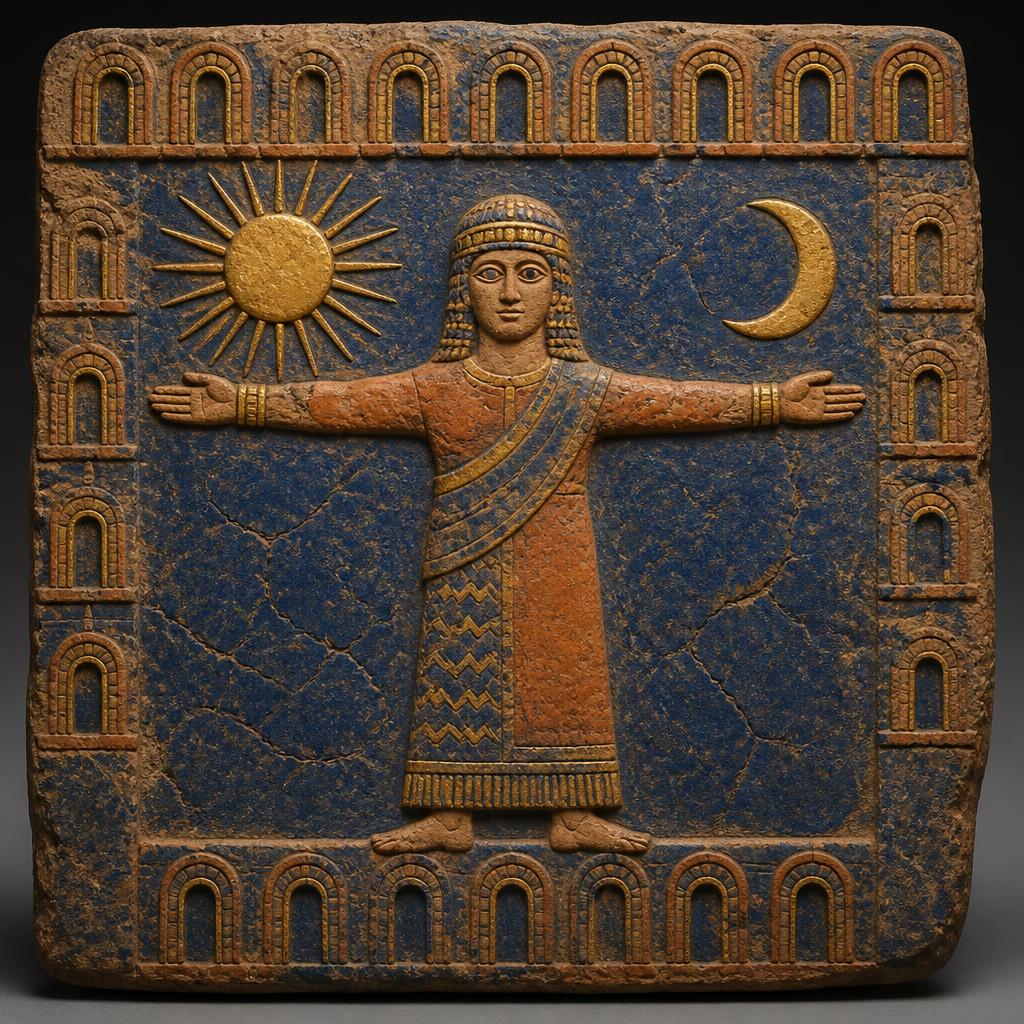
Practice now
Stand only as long as it is comfortable. Lower your arms if you feel strain, dizziness, or pain. This is a contemplative practice, not medical treatment.
Solar noon
When the sun is at its highest for your exact coordinates — not clock noon.
Solstice & equinox
The threshold moments of the solar year, computed for your location.
When receiving
Reading a source, working the calendar, or teaching another.
What people commonly report: the chest opens, the shoulders take on real work, the breath slows. Attention narrows to the shape you are holding. That is the whole of it — an ordinary body doing a deliberate thing, on purpose, at a moment chosen by the sun.
VI · The T in architecture
Every T is a gate
The djed pillar
Egyptian sign of stability, read as the backbone of Osiris.
Tau doorways
T-shaped openings appear in Maya and other ancient architecture as thresholds.
The tau cross of St. Anthony
Carried as a sign of protection and healing in later Christian practice.
Post and lintel
The oldest way to make a doorway at all: one span held up by uprights.
VII · The restoration of the tau
Assume the posture
Here the tau is the working sign: in the mark, in the throne diagram, in the practice at solar noon, and at the sites where the pillars still stand. Not because the older shape defeats the newer one, but because extension is the meaning we keep.
Assume the posture. Become the keeper. Restore the time.
Share this practice
Choose a caption, then copy the link to post anywhere.
76 / 280 characters. Pastes as plain text — paste into any app to share.
You have stood at this gate 0 times in this browser.
Share this page
Dates for Göbekli Tepe, Cahokia, and Roman crucifixion practice follow published archaeological and historical scholarship; the readings of 1 Enoch and of the T-shape offered here are interpretations for study and personal practice, not established fact. The posture is a contemplative exercise. It is not medical, psychological, or spiritual treatment, and no outcome of any kind is promised. Stop if it hurts.